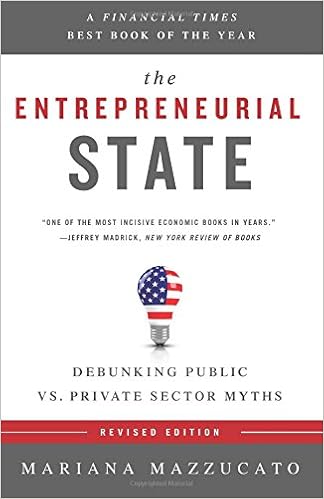
The Entrepreneurial State (2018 Edition) : Debunking Public vs. Private Sector Myths - Mariana Mazzucato Audiobook
Language: EnglishKeywords:
Business
Economics
Politics
State-innovation
Shared by:daenigma100
Written by
Format: MP3
Bitrate: 64 Kbps
This book debunks the myth of the State as a large bureaucratic organization that can at best facilitate the creative innovation which happens in the dynamic private sector. Analysing various case studies of innovation-led growth, it describes the opposite situation, whereby the private sector only becomes bold enough to invest after the courageous State has made the high-risk investments.
The volume argues that in the history of modern capitalism, the State has generated economic activity that would not otherwise have happened, and has actively opened up new technologies and markets that private investors can later move into. Far from the often heard criticisms of the State potentially ‘crowding out’ private investments, the State makes them happen, shaping and creating markets, not only ‘fixing’ them. Ignoring this reality only serves ideological ends, and hurts effective policymaking.
This book examines case studies ranging from the advent of the Internet to the emergence of the biotechnology and nanotechnology industries. In particular, the volume debunks the myth that Silicon Valley was created by entrepreneurial venture capital. A key chapter focuses on the State investments behind Apple’s success, and reveals that every major technology behind the iPhone owes its source to public funds. Thus, while entrepreneurial individuals like Steve Jobs are needed, their success is nearly impossible without their ability to ride the wave of State investments. And if Europe wants its own Googles, it needs more State action, not less.
Two forward-looking chapters focus on the emergence of the next big thing after the internet: the ‘green revolution’. Both solar and wind technology are currently being led by State spending, whether through the US ARPA-E programme or the Chinese and Brazilian State investment banks. The discussion refreshingly moves beyond the usual division between proponents of austerity vs. the proponents of fiscal stimulus. It argues that State investments not only help kick-start growth during periods of recession, but that they also, even in boom periods, lead to productive investments in radical new technologies which later foster decades of growth.
The book ends with a fundamental question: if the State is so important to investments in high-risk innovation, why does it capture so little direct return?

| Announce URL: | |
| This Torrent also has several backup trackers | |
| Tracker: | udp://tracker.opentrackr.org:1337/announce |
| Tracker: | udp://tracker.leechers-paradise.org:6969 |
| Tracker: | udp://tracker.coppersurfer.tk:6969 |
| Tracker: | udp://tracker.open-internet.nl:6969/announce |
| Tracker: | udp://tracker.torrent.eu.org:451/announce |
| Tracker: | udp://tracker.tiny-vps.com:6969/announce |
| Tracker: | udp://open.demonii.si:1337/announce |
| Tracker: | udp://thetracker.org:80/announce |
| Tracker: | http://tracker2.dler.org:80/announce |
| Creation Date: | Tue, 04 Aug 2020 19:20:15 +0100 |
| This is a Multifile Torrent | |
| Mariana Mazucato - The Entrepreneurial State Audiobook.mp3 261.91 MBs | |
| File Size: | 261.91 MBs |
| Piece Size: | 512 KBs |
| Comment: | Updated by Business Audiobook |
| Encoding: | UTF-8 |
| Info Hash: | ba271e396828040a7f670c86d16b194a01ade2ad |
| Torrent Download: | Torrent Free Downloads |
| Tips: | Sometimes the torrent health info isn’t accurate, so you can download the file and check it out or try the following downloads. |
| Direct Download: | Start Direct Download |
| Tips: | You could try out alternative bittorrent clients. |
| Secured Download: | Download Files Now |
| AD: |

|





This post has 3 comments
August 4th, 2020
The book shouldn’t end with that “fundamental question” - it should begin with it. Also the issue of why there is so much catastrophic waste of “State” money (of course, it’s not the State’s money - it is the money of all of the individual citizens, taxes levied on crucial economic activity - without which, nothing can happen).
There’s a balance to be struck betw public & private, but there seems never to be a drive for efficiency in the public sector, only an impetus towards more bureaucratic empire-building, and jobs for the boys & girls. We’ve seen the ideological State at its very worst, where it controls everything - and this only leads to disaster. Certainly not technological or creative innovation, only the dead hand of the State itself.
August 5th, 2020
i think your comment about “there never seems to be a drive for efficiency in the public sector” is misinformed - I can tell you that doing more with less is basically a general reality of any government employee, particularly at the state and local level. I am going to place the federal government to the side, however I think there are remarkable things happening there too. A good book on the latter topic is ‘The Fifth Risk’ which is really powerful, and also happens to describe some of the organizational brilliance you can find if you look. Finally, many public sector employees pull rabbits out of hats all the time, but we don’t go blowing our horns, etc. It’s not an ‘us vs. them’ thing, just more of a request for some kind of understanding.
Are there inefficiencies in government? Yes - that is how it is supposed to be (the opposite of that is a non-democratic society). Inclusion takes longer. Authoritarianism is far more efficient but I don’t hear too many people looking to solve problems by going that route.
August 6th, 2020
You speak a lot of sense there, and I’m certainly not impugning the incredible work that’s regularly done at the front line (I worked for many years in the public sector, in the area of health). In my country, so much money and resources are pumped into failing public initiatives, with annual budgetary increases waved through, and largely unquestioned cost overruns being the norm. And we would not be exceptional at the international level.
The fact that the people’s money is at stake should mean tighter controls and responsible oversight regarding the ever-present incompetence & inefficiency, corruption, colossal waste of public money, bureaucratic empire-building, official mendacity & deceit, pointless duplication, lack of accountability, repeating the same errors over & over, etc. etc.
As I said, there’s a critical, rational balance to be struck between public & private, and we can’t expect every public department to turn a profit, as businesses are supposed to do. Things like justice, health, education & social welfare are enormously costly, and this is to be expected. Democratic institutions are, of course, far from cheap (although political representatives often look quite cheap).
It would be absurd to think of these areas in terms of the dynamics of entrepreneurialism. They are investments by the people, in people themselves. The tragedy is, that because of the enormous waste, there is so much less to invest in the social programmes which are so badly needed.
Add a comment